
Japanese Design Archive Survey
DESIGN ARCHIVE
Designers & Creators
Tadaomi Mizunoe
Furniture designer
Interview: 13 November 2025, 13:30–15:30
Location: Tendo Mokko
Interviewees: Mr Naoki Kato (Planning Department, Tendo Mokko), Mr Junpei Deguchi (D Interior Director)
Interviewer: Aia Urakawa
Writing: Aia Urakawa
PROFILE
Profile
Tadaomi Mizunoe
Furniture designer
1921 Born in Oita Prefecture
1941 Graduated from the Department of Architecture, Nihon University Professional Division (now Nihon University)
1942 Joined Kunio Maekawa Architects & Associates (currently Maekawa Associates, Architects & Engineers)
Enlisted in the Japanese Army as an active-duty soldier
1945 Discharged from military service following the end of World War II
1953 Returned to Kunio Maekawa Architects & Associates
1954 Furniture for the furniture at Kanagawa Prefectural Library
Designed the “S-0507” chair, later manufactured by Tendo Mokko Co., Ltd.
1955 Furniture for the International House of Japan
1958 Member, Interior Planning Committee, Architectural Institute of Japan (AIJ)
Co-founded the Japan Interior Designers’ Association (JIDA), Served as a board director
1959 Executive Committee Member, World Design Conference (WDC)
1963 Left Kunio Maekawa Architects & Associates
Founded the Mizunoe Interior Design Institute
1964 Planned and designed the exhibition “Hans Wegner Exhibition” (Isetan Department Store, Tokyo)
Dispatched to the United States for negotiations between Isetan and Herman Miller regarding their business partnership
Traveled to Italy, Sweden, and Finland for furniture research and study
Appointed advisor to Modern Furniture Sales, the exclusive Japanese distributor of Herman Miller
1965 Lecturer, Department of Housing and Architecture, Faculty of Home Economics, Japan Women’s University (–1967)
1968 Became a member of the Japan Design Committee
1971 Held the exhibition “Furniture Collection by Daisaku Cho, Tadaomi Mizunoe, and Katsuo Matsumura”
1972 Received the Mainichi Industrial Design Award
1975 Planned and designed the exhibition of furniture by Alvar Aalto for Artek (Nissei Hall, Tokyo)
1976 Chairman of the Jury, “Design Forum ’76” Open Competition organized by the Japan Design Committee
1977 Passed away at the age of 56
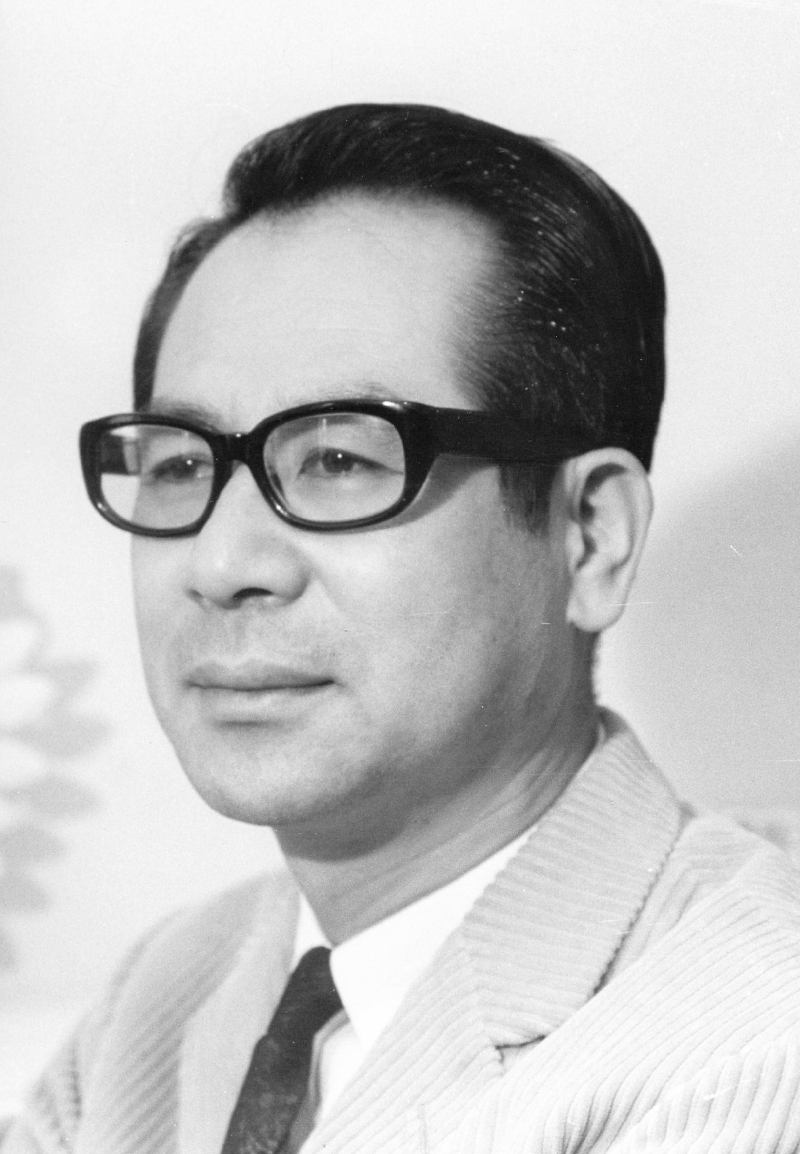
Description
Description
Tadaomi Mizunoe was a furniture designer active during the dawn of Japanese furniture design. In the post-war period, when Japan saw much imitation of overseas styles and an abundance of eccentric forms prioritising appearance alone, Mizunoe stated in a magazine article: “For designers and manufacturers alike to catch up with the world's mainstream, unless they consider solving fundamental problems concerning furniture itself, the path forward will not open up.” (Craft News, “Furniture (Interior) ”, Maruzen, 1962).
Born in Oita Prefecture, Mizunoe graduated from the Architecture Department of Nihon University College (now Nihon University). In 1942, he joined the Maekawa Kunio Architectural Design Office (now Maekawa Architects & Associates), where he was responsible for furniture design. At that time, the architectural practices of Japan's three leading architects – Junzo Sakakura, Kunio Maekawa, and Junzo Yoshimura – each had dedicated furniture departments. Young designers such as Daisaku Cho, Tadaomi Mizunoe, and Katsuo Matsumura were appointed to these departments, taking charge of furniture design accompanying the architecture. Until then, furniture for architectural spaces had been produced by department store furniture departments or industrial craft laboratories. However, around 1940, the establishment of furniture departments within architectural practices began to attract significant attention.
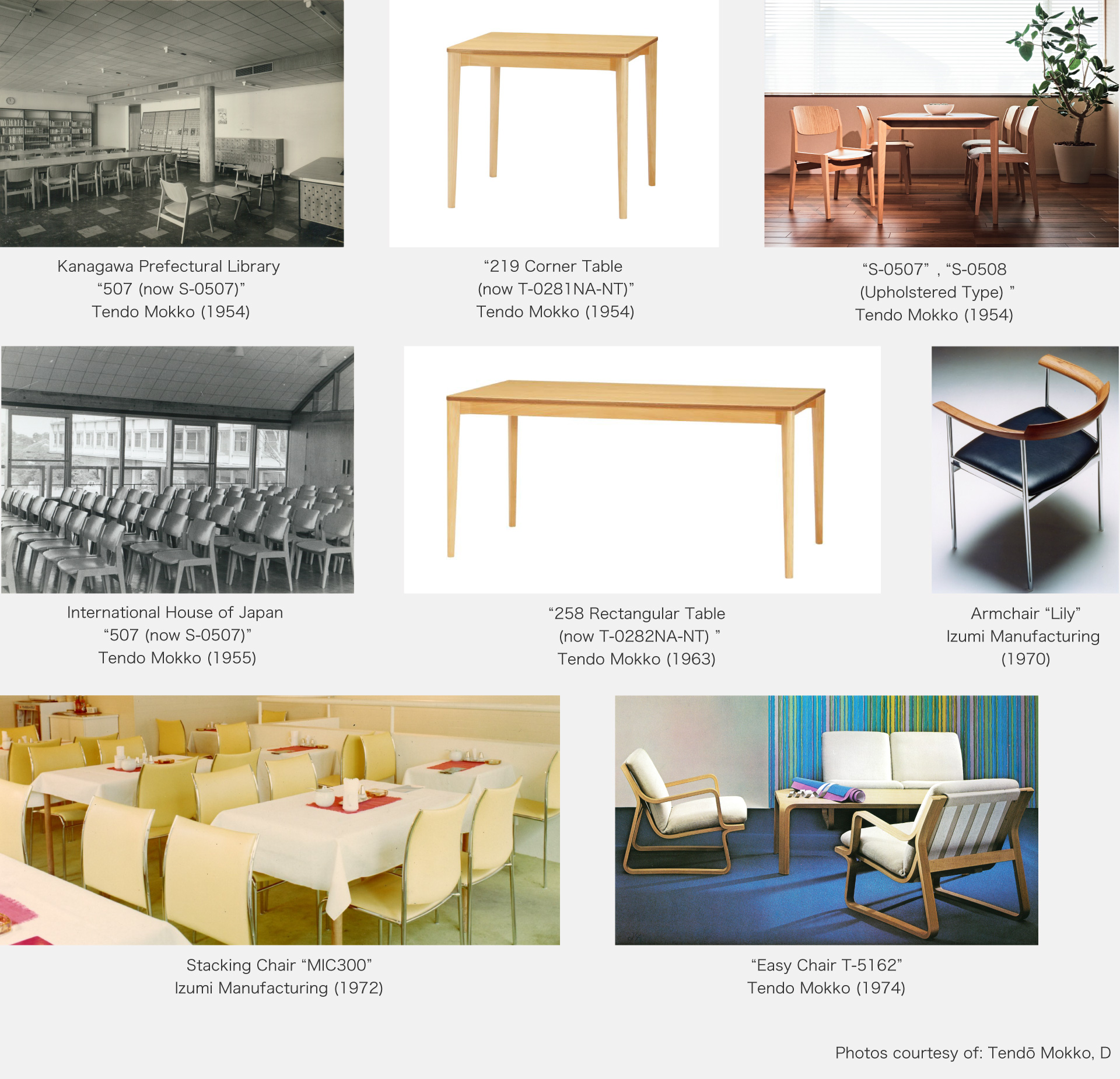
Mizunoe's signature piece, the “507” (now S-0507, commonly known as the Book Chair), was created for the Kanagawa Prefectural Library, designed by Maekawa and completed in 1954. After over 100 prototypes and continued refinement even after the library's completion, he poured his lifelong passion into this single piece. Beyond pursuing aesthetic form, he worked in close consultation with factories to achieve furniture that was affordable, easy to mass-produce, durable, and long-lasting. The joint design by Sakakura, Maekawa, and Yoshimura for the International House of Japan, completed in 1955, attracted considerable attention, and the work of Cho, Mizunoe, and Matsumura, who were responsible for the furniture, was also highly praised.
Mizunoe also actively studied and absorbed overseas design. In 1964, he inspected furniture in America and Europe, broadening his horizons through exchanges with contemporary designers such as Hans Wegner, George Nelson, and Charles Eames. He frequently studied foreign design magazines. He explained his reasoning in Designer: Reality and Vision (Diamond Shuppan, 1964). “Later, ‘I didn't know’ won't suffice. One must know, resist it, and conceive something different. ” When magazines arrived, he would immediately take them apart, note the magazine name and issue number in pencil, and sort them into bags by category. That task was a joy to the heart,’ revealing how he organised the magazine articles.
Though his output was sparse due to his untimely death at 56, the Book Chair, produced by Tendo Mokko since 1954, remains a long-selling favourite nearly 70 years later. It is recognised as a masterpiece in Japanese furniture design history. Professor Emeritus Nobu Shimazaki of Musashino Art University states: "It could be considered one of the consummate examples of modern Japanese chairs. [...] He also crafted a lounge chair using the same moulded plywood, which is also a splendid design. It is an indispensable chair when discussing modern Japanese chairs." (Suwatte Manabu isugaku 2 – Musabi modan chea korekushon 400kyaku, Musashino Art University Museum & Library, 2018).
Mizunoe's archival materials are currently held by Tendo Mokko's Tokyo branch. In November 2016, during an interview for the PLAT Design Archive about the archives of Cho, we were also shown Mizunoe's materials. It was compiled by Junpei Deguchi, then a student, as the research topic for his graduation thesis in Mr Mitsuo Ohkawa's laboratory at the Department of Architecture, Faculty of Science and Technology, Nihon University in 2014. On this occasion, we revisited Tendo Mokko and spoke with Mr Naoki Kato of the company's Planning Department and Mr Deguchi about Mizunoe's archive materials and his character.
Masterpiece
Masterpiece
Furniture design
“507 (now S-0507) ” Tendo Mokko (1954), “219 Square Table” Tendo Mokko (1954), “Lobby Chair” Izumi Seisakusho (1960), “258 Rectangular Table” Tendo Mokko (1963), “M Series Small Chair” Futaba Kogyo (1967), “Katsura” Hokuto Metal (1967), “Hato No.210M” Sanpei Kogyo (1967), Armchair “Lily” Izumi Seisakusho (1970), “Armchair” Yamakawa Rattan (1971), “Easy Chair” Tendo Mokko (1972), Stacking Chair “MIC300” Izumi Seisakusho (1972), “Easy Chair T-5162” Tendo Mokko (1974)
Contributions to Books & Magazines (Furniture Design Advocacy)
“World Art Collection”, Japan Edition, Vol. 28, Heibonsha (1955); “International Architecture” ‘Conditions Prior to Form: From Design to Production of Mass-Produced Chairs”, Bijutsu Shuppansha (1955); “International Architecture: “What Madame Perriand Teaches Us”, Bijutsu Shuppansha (1955); “International Architecture” ‘The Nor Group: Furniture Collection and Interior Design’, Bijutsu Shuppansha (1956); “Interior JAPAN INTERIOR DESIGN and DECORATION” ‘My Design’ No.1, Japan Interior Design Institute (1960); “International Architecture” ‘NO FURNITURE: George Nelson's Proposal for Built-in Furniture’, Bijutsu Shuppansha (1960); “Crafts News” ‘Furniture (Interior)’ Maruzen (1962); New Architecture July issue (1962), New Furniture No.6 Arthur Niggli (1963); Designer by Jun Kawahara, Diamond Inc. (1964); “Interior” ‘World Design Tour: Japan’ Interior (1964); “Furniture Industry” ‘Designers: The Person and Their Work’ Japan Furniture Manufacturers Association (1968); “Furniture” ‘The Designer Who Continues to Maintain His Own Pace’ Publisher unknown (1970); among others.
Interview
Interview
Introduction
In November 2016, I was shown Mizunoe's materials at Tendo Mokkō. These materials, donated to Tendo Mokko by his son after Mrs Mizunoe's passing, reportedly filled three paper bags at the time. Additional materials were later donated by individuals who had been close to Mizunoe. The collection includes drawings, sketches, letters, and prototype furniture pieces used in his home. It also contains two prototypes of his signature piece, the “507”, allowing one to observe the difference in the rounded corners of the left and right frames. There is an anecdote that the “507” underwent over 100 adjustments. At the time, Tendo Mokko's meeting room was reportedly filled to capacity with Mizunoe's prototypes, indicating a considerable number were produced.
Other materials include a collection of approximately five albums containing numerous negatives of photographs taken of classic chairs. They bear his address, name, and telephone number, presumably in case of loss, suggesting these were valuable materials for Mizunoe. Also present are overseas magazines, a special issue of “Shin Kenchiku” featuring young architects (containing articles on Daisaku Cho, Katsuo Matsumura, and Mizunoe), letters from Charles Eames and Hans Wegner, and a note of “thank you” likely written by Eames himself.
Researching materials for my university graduation project
ー What kind of work are you currently engaged in, Mr Deguchi?
Deguchi After graduating university, I worked for an interior manufacturer for 9 years before becoming independent in 2025. I now operate as a director specialising in furniture production, encompassing spatial design. I interpret the design intent and project background to propose spaces and furniture that align with the purpose and contemporary context. I am responsible for acting as a bridge between designers and factories, travelling nationwide to investigate everything from materials and factory techniques to the character of the factory managers.
ー So you graduated from the same architecture department at Nihon University as Mr Mizunoe?
Deguchi I studied architecture at the Faculty of Architecture. My origins lie in seeing my carpenter cousin building houses when I was young and thinking, “Making things is wonderful. ” Since then, I vaguely wanted to work in a craft-related field. Later, encountering mid-century works by Charles Eames and George Nelson, and Scandinavian pieces by Hans J. Wegner and Finn Juhl, deepened my interest in furniture. I chose to major in architecture, thinking I would first gain a broad understanding of architecture as a whole and then eventually connect that to furniture work.
ー I understand you researched Mr Mizunoe's archive materials for your graduation project. Previously, when interviewing Mr Hideki Nagasaka of Tendo Mokko for the PLAT design archive, I heard from Mr Nagasaka that the connection between the professor at Nihon University and Mr Mizunoe was what prompted Mr Deguchi's research.
Deguchi I believe it was Professor Mitsuo Ohkawa from the Okawa Laboratory where I was based. After enrolling, I consulted him, saying, ‘I'd rather study furniture history than architecture.’ He recommended historical research, saying, ‘There's a specialisation that suits you.’ Within that specialisation, many seniors were researching the architectural histories of Junzo Sakakura, Junzo Yoshimura, and Kunio Maekawa. Apparently, the presence of Mr Mizunoe, who worked as a furniture designer at Kunio Maekawa's office, was also a topic of discussion. However, as no students showed strong interest in furniture, research hadn't progressed. Against this backdrop, my enrolment as someone interested in furniture led Professor Okawa to propose researching Mizunoe. I eagerly accepted, and the archival research began.
ー Did you know about Mr Mizunoe at the time?
Deguchi No, I didn't. Though I was fond of furniture, I was studying architecture until my third year. What I heard from my professor was that Mr Mizunoe had worked at Kunio Maekawa's office, designed outstanding chairs, and achieved much, yet remained underappreciated. He told me, “Research this man,” and ‘We'll work out the presentation together.” I began my research in my fourth year.
ー The materials prepared for us today by Mr Kato (Tendo Mokko) are the complete collection you compiled, aren't they? The documents are housed in envelopes that appear to be from the same manufacturer, and these are further contained within a box. Was it your professor who selected these envelopes and box?
Deguchi Yes, the professor said, “These are extremely valuable materials,” and arranged for envelopes and boxes made from materials resistant to paper oxidation. Since most of the materials are paper, there is a risk that they could crumble to pieces if oxidation progresses later on.
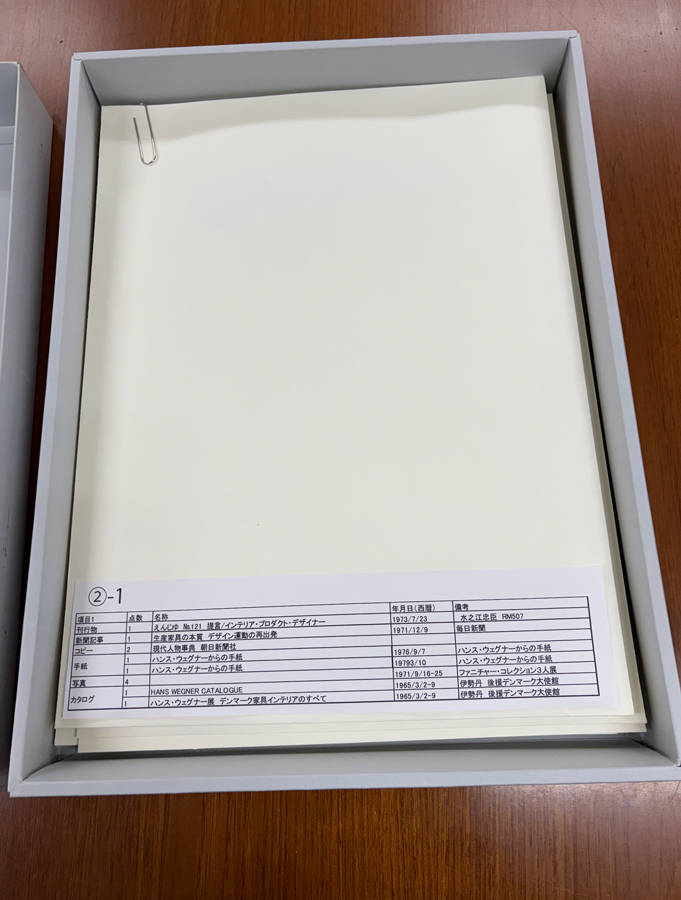
The archival materials of Mizunoe are stored in oxidation-resistant envelopes and boxes.
Achievements and Roles Revealed Through Historical Context
ー Mr Deguchi's graduation thesis, which summarises the contents of Mr Mizunoe's archive materials, has been compiled into a single booklet, hasn't it? It also covers the history of Japanese furniture design and proved a thoroughly engaging read. When compiling the archive materials, what was the first step you took?
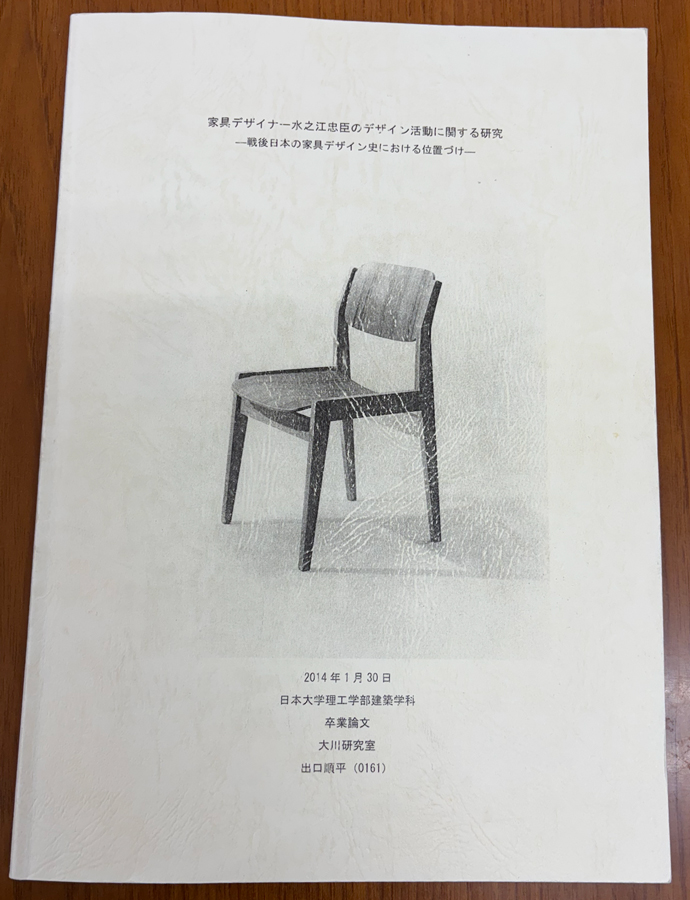
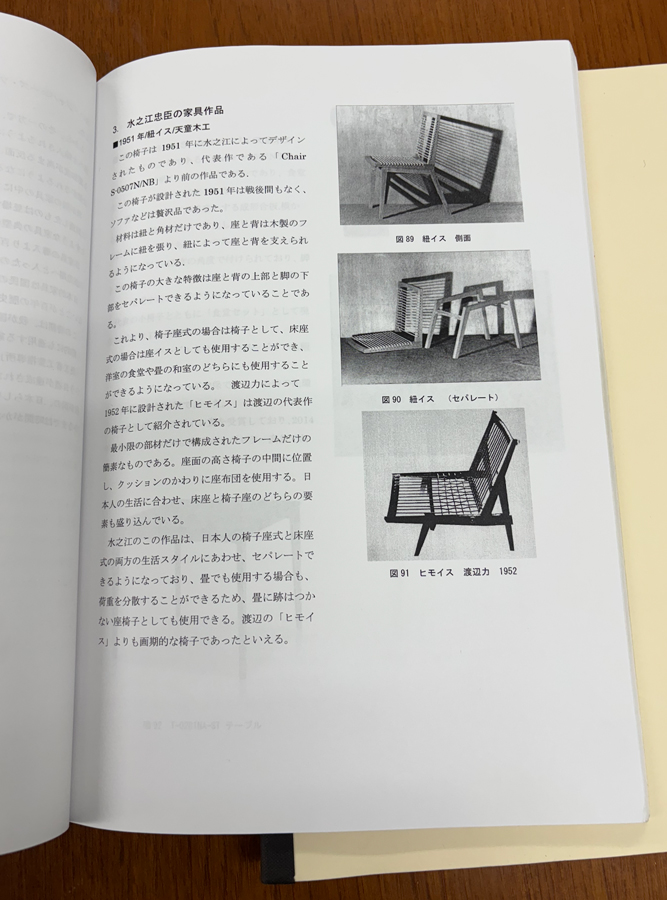
Mr Junpei Deguchi's graduation thesis.
Deguchi I began by researching the history of Japanese furniture design from the 1920s onwards. Without understanding the historical context, it would be impossible to discern what role Mr Mizunoe played and in which era. My professor handed me a rather substantial volume, Keiji kobo (Bijutsu Shuppansha, 1987), some 500 pages thick, which I studied thoroughly. This book comprehensively covers the thinking and experiments surrounding furniture design at the time, including the Industrial Crafts Guidance Institute and Mr Katsuhei Toyoguchi's experiments of sitting on snow to mould the shape of the human body.
Subsequently, I contacted Tendo Mokko and spoke with Mr Mizunoe, Mr Mizunoe's son. I was then able to borrow the archive materials, which significantly accelerated my research.
ー How were Mr Mizunoe's archive materials stored?
Deguchi The materials were sorted into envelopes by type. The way they were organised conveyed Mr Mizunoe's areas of interest just by looking at them. I understand he made a rough classification himself initially, and his wife then organised them further. From that classification method, I sensed Mr Mizunoe was a meticulous man with strong convictions. On the other hand, some items were placed in envelopes without concern for slight creases in the paper.
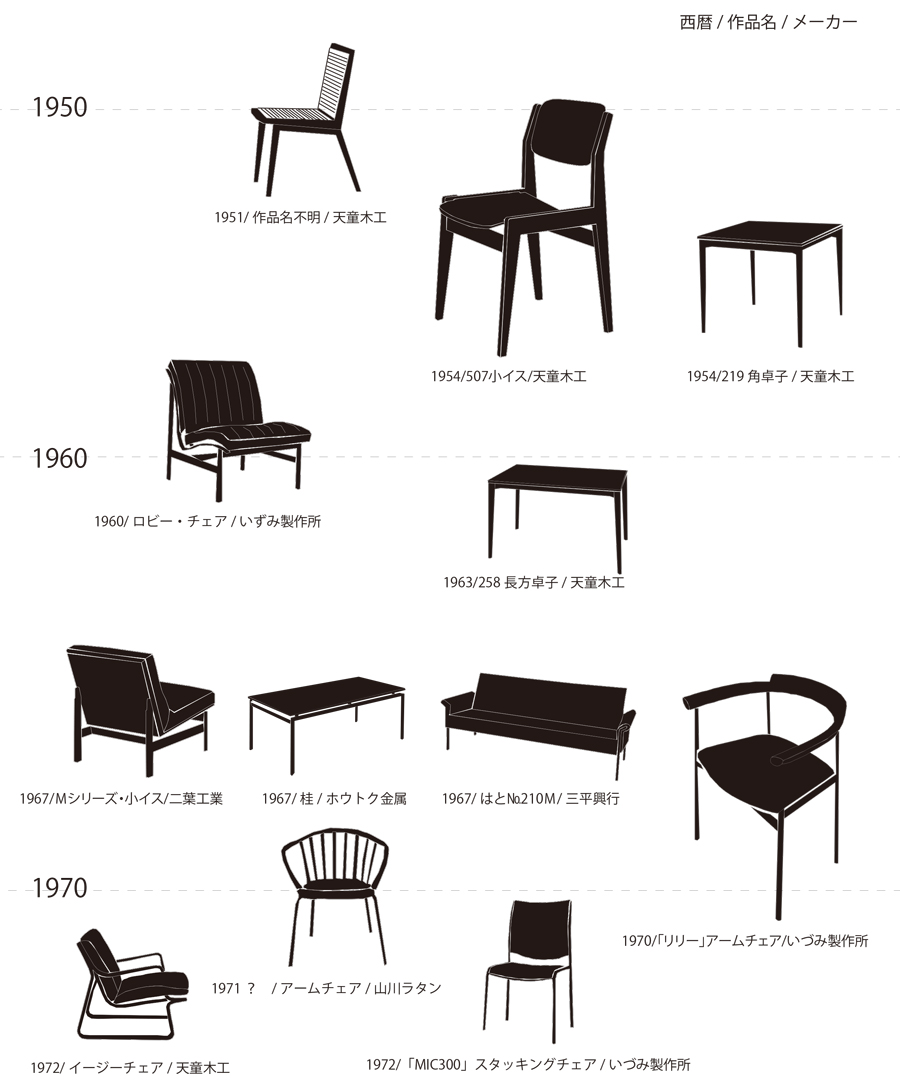
The list of furniture in Mizunoe compiled by Mr Deguchi.
ー How did you organise these materials, Mr Deguchi?
Deguchi First, I created my own chronology based on my research into the history of Japanese furniture design. I then incorporated the contents of Mr Mizunoe's archive materials into it. I narrowed it down to three points that seemed likely to be turning points: his time at the Maekawa Office, his time as the Japanese representative for Harman Miller, and his meeting with Hans Wegner. As I read through the archive materials, I found many notes with dates written on them, so I made educated guesses and placed them in the chronology according to those dates.
Investigating the state of furniture design both domestically and internationally
ー In PLAT's design archive interviews, designers typically provide materials related to their own work, such as photographs, drawings, and sketches. In Mr Mizunoe's case, however, it seems you have collected a great deal of materials concerning the furniture industry itself.
Deguchi Quite a lot indeed. His son mentioned that Mr Mizunoe frequently collected newspaper and magazine clippings. There were industry publications akin to trade journals detailing the furniture sector's trends at the time, and these clippings were meticulously organised and stored in envelopes. This is purely my conjecture, but I suspect Mr Mizunoe conducted this research to identify suitable factories for his own furniture production. Markings on production volumes and costs suggest he was assessing efficiency and productivity. Furthermore, I imagine he researched in detail what kind of company the factory was, what sort of person the president was, who the technical director was, and so on. He would have determined whether it was a company he wanted to work with before building a relationship.
Among the materials was an article where Mr Mizunoe used the term “Four Virtues Doctrine” to emphasise that good products emerge when designers, producers (factories/manufacturers), sellers, and consumers maintain positive relationships, and that manufacturing where all parties benefit is crucial.
There were also notes summarising lectures given by George Nelson at the Industrial Arts and Crafts Institute. Nelson apparently discussed the ideal relationship between designers and manufacturers, as well as furniture pricing, in his lectures. Through Nelson's lectures, Mr Mizunoe likely gained confirmation of his own ideas.
Additionally, newspaper clippings about Mr Shiro Kuramata were preserved, suggesting Mr Mizunoe may have been following Mr Kuramata's activities.
※ “Designers provide producers and sellers with profit as a commodity, whilst offering consumers the use value of the product as a commodity possessing a fair price. Through this, designers enable producers and sellers to develop markets, thereby receiving the benefits of design as a reaction to this process” (Interior JAPAN INTERIOR DESIGN and DECORATION, No. 1, Japan Interior Design Institute, 1960).
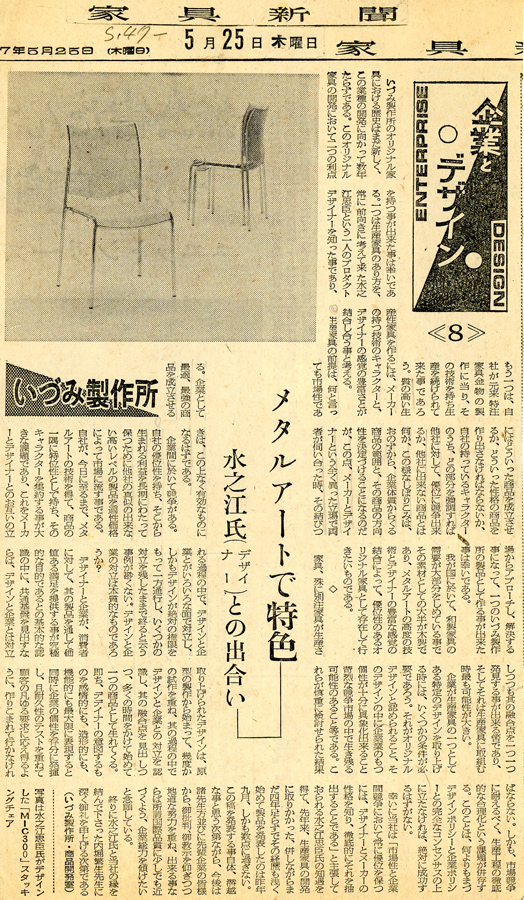
An article from Mizunoe's reference work, “Furniture News”.
ー Mr Mizunoe also travelled abroad to inspect furniture manufacturers, so he must have learnt a great deal from those visits. I read several magazine articles he wrote about foreign furniture at the National Diet Library. These included NO FURNITURE: Built-in Furniture Proposals by George Nelson (“Kokusai Kenchiku”, Bijutsu Shuppan-Sha, 1960) and The Noll Group: Furniture Collection and Interior Design (“Kokusai Kenchiku”, Bijutsu Shuppan-Sha, 1956).
Deguchi Mr Mizunoe travelled to the United States in February 1964 for meetings concerning a partnership between Isetan and Harman Miller. At that time, he was also requested to visit Europe to inspect furniture, and visited Italy, Sweden, Finland and Denmark. He must have brought back various materials from those trips. He was also involved in the activities of the Japan Design Committee, and I imagine he had a fairly comprehensive grasp of the furniture design industry both in Japan and abroad.
ー The critic and editor Masaru Katsumi also researched design extensively both in Japan and abroad. Like Mr Katsumi, Mr Mizunoe's wide-ranging research and investigative approach also conveys a desire to improve Japanese furniture design. What are your thoughts on this point, Mr Deguchi?
Deguchi I couldn't glean that much from the materials from his time at Kunio Maekawa's office, but in June 1964, Mr Mizunoe became an advisor to Modern Furniture Sales, the general agent for Harman Miller in Japan. I suspect that after actually travelling to the United States and seeing the excellence of American manufacturers such as Harman Miller with his own eyes, he thought that Japanese furniture manufacturers should be like this, and that unless they did, the industry would not improve. His change in thinking can be seen from the fact that after becoming involved with Harman Miller, he organised and scrapbooked articles from furniture magazines by era.
Representative work: Book Chair
ー Did you sense anything of Mr Mizunoe's character from the archive materials?
Deguchi I felt he was someone who wouldn't do anything illogical. There are documents showing Mr Mizunoe giving instructions for chair design revisions, to which the Technical Director of Tendo Mokko responded with handwritten notes, with several exchanges taking place. From the content, it’s clear they were thoroughly debating price and manufacturing processes. As the manufacturing process directly impacts price, they were meticulously discussing points like whether production could be sped up or more efficient methods found. I believe these exchanges took place around 1957, and the immediacy of the situation came across very strongly.
Kato The technical director believed to have been involved in that correspondence would have been Mr Saburo Inui, as Mr Inui joined the company in 1958. The year 1957 corresponds to the chair “507” (now S-0507), produced for the Kanagawa Prefectural Library. That chair underwent continuous fine-tuning even after its release. Fondly known as the Book Chair, it remains a long-selling product to this day. Among Tendo Mokko's offerings, it is both the most affordably priced and the chair with the longest-standing sales record.
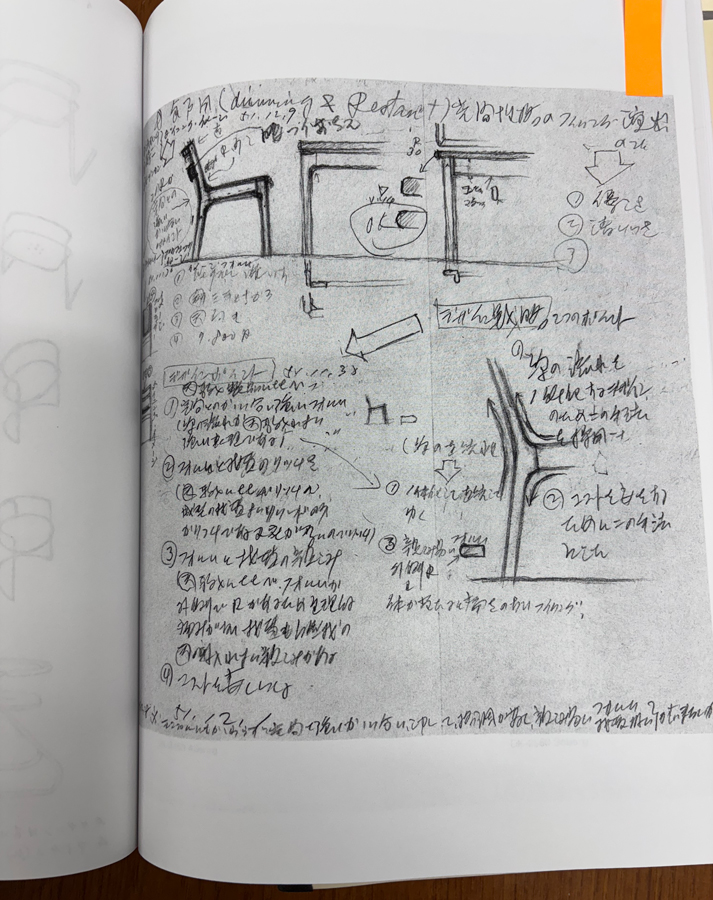
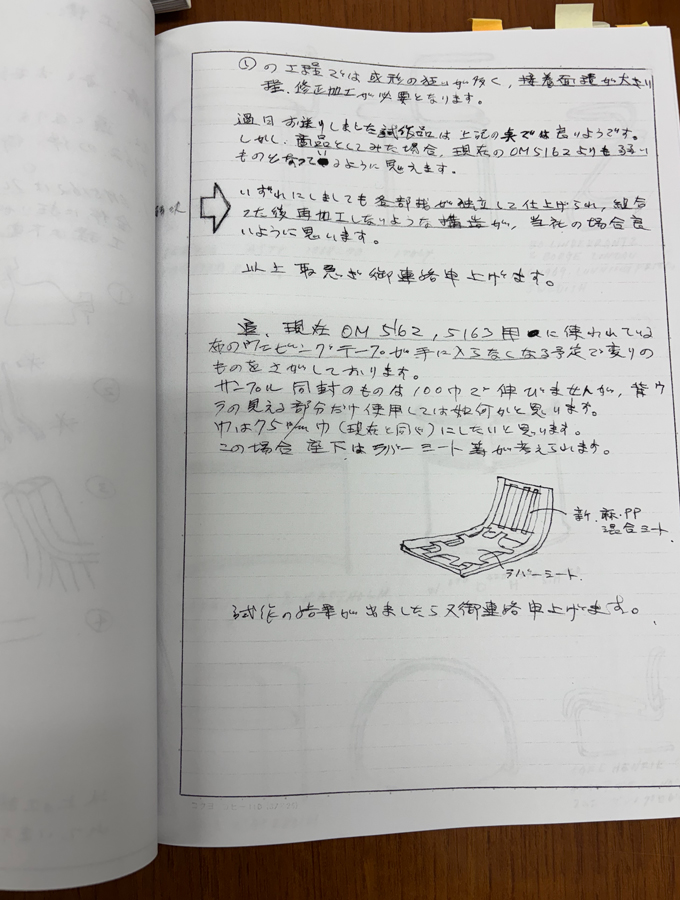
Documents exchanged between Tendo Mokko's factory and Mizunoe.
ー I recall Mr Cho mentioning that Mr Mizunoe would call Tendo Mokko first thing every morning, gradually refining the chair's design through successive revisions. If I were to name just one masterpiece among Japanese furniture, it would undoubtedly be the Book Chair. The first time I sat in it, I was genuinely astonished by its comfort. That exceptional comfort, I believe, is also a testament to Tendo Mokko's technical prowess.
Deguchi For Mr Mizunoe, collaborative creation with workshops like Tendo Mokko was profoundly important. Craftsmanship evolves not through the efforts of a single designer, but through a relationship of mutual elevation with the craftsmen.
It is said that the exchange between Hans Wegner and Mizunoe began when their furniture was featured on the same page of the German furniture yearbook “New Furniture No.6” (published by Arthur Niggli) in 1963. In January 1964, Mizunoe planned and designed the exhibition for the “Hans Wegner Exhibition” at Isetan. During a study tour to America and Scandinavia in June that same year, he was invited by Wegner to visit Denmark as a guest. Among the materials, there is an account describing how, in Denmark, he witnessed Wegner's furniture being used quite naturally within everyday spaces. He was profoundly struck by the Scandinavian culture where furniture blends deeply into daily life.
Perhaps influenced by Wegner, Mizunoe made further alterations to the Book Chair design around this time. However, changing the design also altered the wood cutting patterns, affecting efficiency, productivity, and material procurement. His back-and-forth negotiations with the technical director clearly conveyed how he worked through these issues, balancing design with production feasibility. Designers like Mr Mizunoe, who engage with the same manufacturer for decades, making minute refinements such as slight leg adjustments or taper modifications, are truly rare. Equally uncommon are manufacturers like Tendo Mokko, possessing the stamina to continually meet such demands.
ー I recall Mr Cho mentioning that Mr Mizunoe and Mr Matsumura often discussed furniture. Were there any other designers with whom Mr Mizunoe was particularly close?
Deguchi When his son was still young, I understand Mr Mizunoe frequently shared drinks with Mr Isamu Kenmochi, and they were very close indeed. Among the archive materials, there remained a note from Mr Kenmochi stating something along the lines of, ‘Mr Mizunoe is a very meticulous person, so please handle this with care.’ I believe it was attached to materials intended for Mr Mizunoe, likely passed on through someone else. Furthermore, when Mr Mizunoe was working at Mr Kunio Maekawa's office, Mr Sori Yanagi's office was located on the first floor of the building. I imagine it was an environment where various architects and designers would come and go.
Mizunoe's Approach to Design
ー Could you share your views on Mr Mizunoe's approach to his work and his philosophy on design?
Deguchi I imagine that for Mr Mizunoe, design encompassed not only the form of the furniture itself, but also the entire process from creation and distribution to its ultimate use.
I feel that his involvement with Harman Miller was the catalyst for this way of thinking. At first, Mr Mizunoe worked at Mr Maekawa's office, repeatedly redrawing sketches for book chairs for the Kanagawa Prefectural Library, refining the furniture itself to perfection. In other words, he spent a period as a pure furniture designer. From there, he moved on to the next stage, which was to consider how to sell the product, focusing on the relationship between the four parties involved: the designer, the producer (factory or manufacturer), the seller, and the consumer. In today's terms, I think he was someone who practised comprehensive design, including management and distribution.
ー How do you perceive the designs themselves?
Deguchi I believe he harboured a strong admiration for curved designs like those of Wegner. There are papers showing he made numerous sketches studying Wegner's characteristics. Ultimately, however, I think he remained true to his own design language. During his time at the Maekawa office, he worked on pieces like sofas for reception rooms, yet even there he avoided extreme curves, favouring designs with honest, straightforward lines.
ー While the furniture of Isamu Kenmochi and Sori Yanagi features distinctive forms, Mr Mizunoe perhaps placed greater emphasis on the perspective of “chairs within daily life” rather than pure form. The phrase “I wish it to be widely used”, found in the notes among the materials, was particularly striking. After all, the Book Chair was originally conceived as a chair for libraries, intended for widespread use by everyone.
Deguchi In the articles within Mr Mizunoe's materials, terms like “the masses” and “everyday items” frequently appear. I believe he understood that unless something was aimed at the masses, it would not endure. Indeed, regarding the Book Chair, which became his signature piece, every aspect – form, design, price, the relationship with the manufacturer, consideration for the user – was thoroughly thought through and ideally aligned. One frequently sees architects, from emerging talents to established masters, incorporating the Book Chair into their projects in magazines, and it's commonly spotted in city restaurants. Many people also cherish it for years in their homes. It adapts to any setting, blending seamlessly into daily life. It truly embodies furniture as a mass-produced daily necessity.
When the Book Chair was created in the mid-1950s, it was an era when only about thirty years had passed since the history of Japanese furniture design began, and the criteria for what constituted “good furniture” had yet to be established. In such a time, I believe Mr Mizunoe dedicated his entire life to creating a chair that is unobtrusively present in daily life yet is, in fact, exceptionally well-made, and he succeeded in achieving that.
Furniture design in the 1960s
ー In Mr Deguchi's graduation thesis, it was written that Japan during the period when Mr Mizunoe was active saw a proliferation of imitation and superficial design. We often hear about imitation from that era, but what exactly constituted superficial design?
Deguchi It seems there was a period when numerous eccentric chair designs appeared, only to vanish the following year. This was after Scandinavian furniture design, and the furniture designs of Mr Sori Yanagi and Mr Daisaku Cho had become established, so probably around the 1960s. They were flashy designs prioritising visual impact; some, like chairs with spiky backs, lacked sufficient consideration for functionality. I imagine they appeared to Mr Mizunoe as poorly designed. On the other hand, I also feel they represented an attempt by young designers to challenge new values.
ー At the time, Tendō Mokkō held furniture design competitions (the Tendo Mokko Furniture Design Contest, which began in 1961). Were such eccentric pieces submitted?
Kato Photographs of all the submitted entries and sketches remain at our company. Given that moulded plywood had become available then, many quite unusual shapes can be seen. Among the competition winners still sold today are highly practical, simple pieces like Reiko Tanabe's “Murai Stool”. With Isamu Kenmochi as chair of the judging panel and members including Kenzo Tange and Katsuhei Toyoguchi, I believe the judging was rigorous.
Deguchi Mr Mizunoe also sketched highly individual concepts, yet the products ultimately released to the market feature pared-down, simple designs.
ー Are there any photographs or drawings preserved in the other archive materials?
Deguchi Drawings from the 1960s have largely been lost, but blueprint copies remain for those from the 1970s onwards. However, storing them as blueprints has its limitations, so I do think it would be better to digitise them via scanning or similar methods.
Photographs are contained within this archive box. While none from overseas inspections were found, there are images of him with Wegner, and photographs capturing him conversing with Nelson during Nelson's lecture in Yamagata.
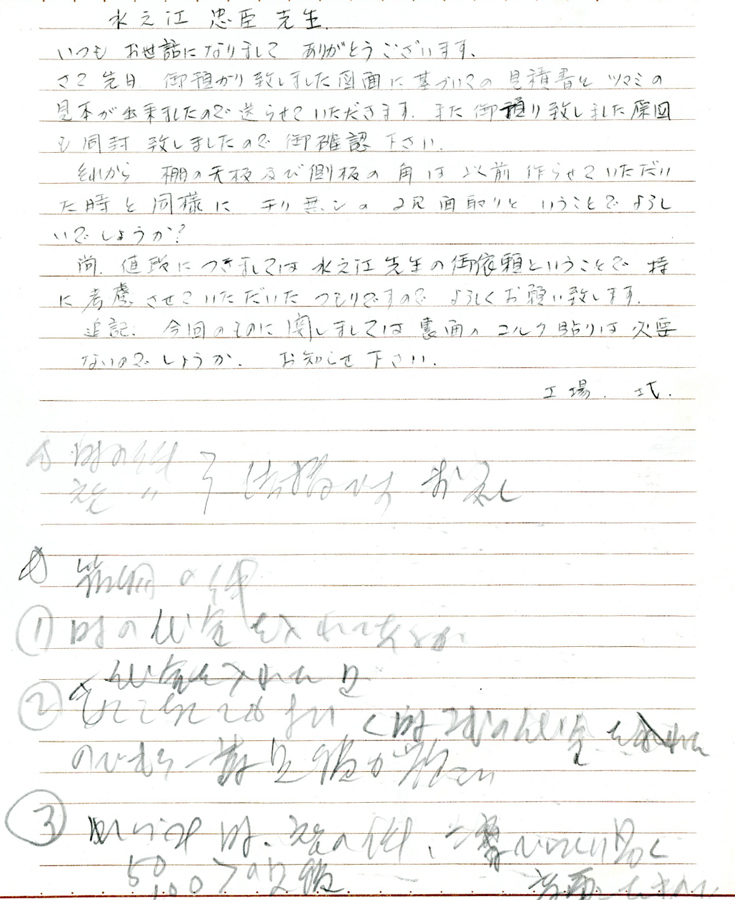
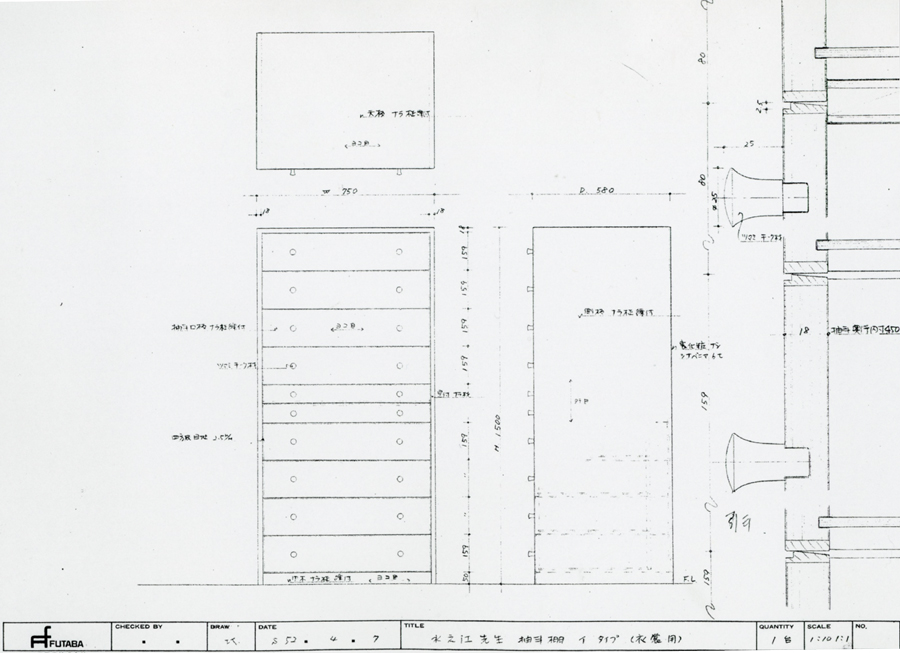
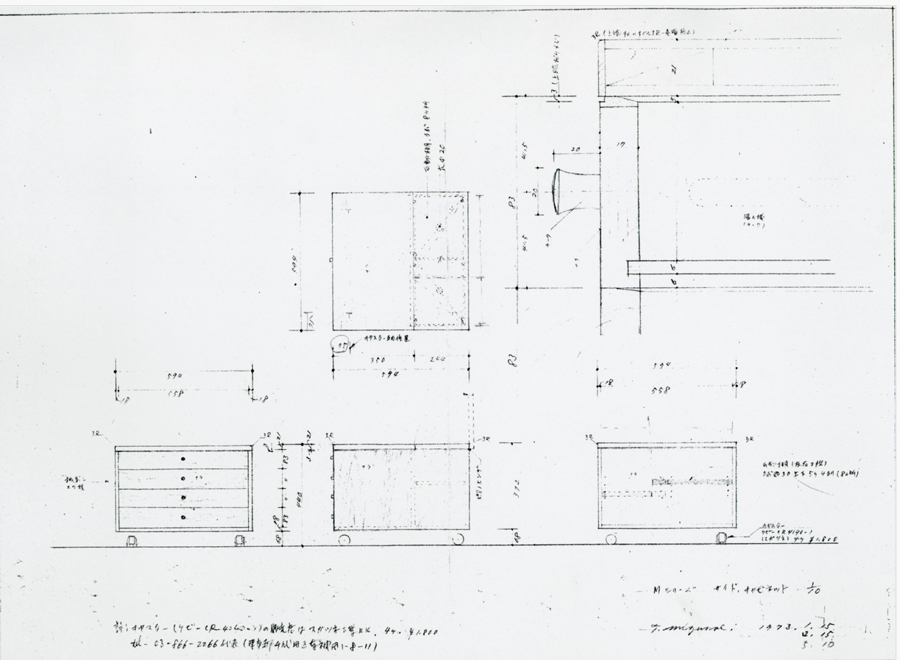
Correspondence and drawings relating to Futaba Furniture.
ー Were there any particular difficulties in compiling the archive materials?
Deguchi I didn't find it particularly difficult. Rather, I thoroughly enjoyed the entire year. Having entered the architecture department, I thought, “Finally, as a fourth-year student undertaking independent research, I can engage with the furniture I love”.
ー Did you ever feel, while compiling the materials, that “it would have been better to have more of this kind of document”?
Deguchi The history of Japanese furniture design, actually. There aren't many books that systematically compile that history to begin with. I believe “Keiji Kobo” is the most well-organised book on the subject.
Therefore, I started by tracing the history of furniture. I read extensively, organising information from manufacturers' books and catalogues, the historical context of each designer's era, and who they were connected to and influenced by. Using manufacturers' trajectories as the horizontal axis and designers as the vertical axis, the challenge lay in grasping the overall picture. To understand this, I needed to physically visit showrooms to see the pieces, tracing each one's production date and development period.
Prospects for a Design Museum
ー How will these archive materials be handled going forward? Would it be best to consult Mr Kato of Tendo Mokko regarding that?
Kato We are deeply grateful to Mr Deguchi for having organised Mr Mizunoe's archive materials so thoroughly to this point. Furthermore, we believe it will be necessary to organise the numerous archives of drawings and other materials from designers with whom our company has collaborated in the past, which remain within our company.
In Japan, there have been several attempts to establish a design museum, such as the Design Museum concept centred around Issey Miyake, but it has yet to materialise. Currently, there is a Design Museum Project involving the Ministry of Economy, Trade and Industry, premised on revitalising Japanese industry. Our company is also involved in this matter and is currently exploring the role we can fulfil as an organisation.
Recently, within this initiative, the idea has emerged that we should not only establish a major base in Tokyo but also focus on regional areas. A proposal has been put forward to create hubs with design museum-like functions across the country, similar to the Japan Folk Crafts Museum, and connect these to a central hub in Tokyo. I believe that establishing such a networked museum system could create a more authentic design museum. Indeed, initiatives like factory tour programmes for regional furniture makers have already begun; just the week before last, many people visited the Tendo Mokko factory. If, hypothetically, a “Tendo Mokko Design Museum” were to be established, I believe it could serve as a hub in Yamagata, connecting with the region's manufacturing industries.
ー It would be wonderful if that could be realised. Mr Deguchi, have you considered compiling this graduation thesis into a book? Combining the history of Japanese furniture design with Mr Mizunoe's materials into a single volume could be a valuable resource for teaching students at universities and other institutions.
Deguchi There are indeed few books that systematically cover the history of Japanese furniture design, so it might be an opportunity to shift the mindset of the younger generation. Opportunities to experience actual furniture pieces are also limited, and there's the current situation where archives aren't sufficiently preserved in museums and such. If I were to write a book about Mr Mizunoe, I'd want to focus more on his relationship with the factory than on the designs themselves. Having seen many factories over the years, I was profoundly struck the first time I witnessed Tendo Mokko's chair-making process. Japanese craftsmanship is, of course, invaluable, but it inevitably drives up costs. Within this context, Tendo Mokko's careful consideration of the balance between price and design remains truly exceptional.
ー What are your thoughts on Japan lacking a dedicated design museum? Specifically for furniture, what kind of museum do you think would be desirable?
Deguchi Like the Louvre or the British Museum, one is first overwhelmed by the sheer scale of the space before even considering the contents. Its sheer scale means you couldn't possibly cover it all in a single day, leaving you with that distinct feeling of wanting to return.
Thinking about it, rather than compact spaces, I believe there is room for design museums that boldly embrace a larger scale. Visitors would first be astonished by the size of the space, and upon seeing the exhibits, they would feel the depth of Japanese craftsmanship, thinking, “So this is the kind of design work Japan produces.”
Take the Vitra Design Museum, for instance. It's renowned for its collection of designer chairs, and upon my first visit, I was indeed overwhelmed by its sheer scale. I imagine a collection of Japanese furniture would be equally substantial. Rather than displaying items in small, compartmentalised sections, one idea might be to arrange chairs across entire walls in a large space, much like the Vitra Design Museum. Placing particularly noteworthy pieces on lower shelves, for instance, could be a way to create a display that conveys a sense of sheer volume. This isn't limited to furniture; I believe design museums are essential for introducing Japanese culture.
ー During my research for the PLAT Design Archive, I have frequently heard that it would be ideal for university students to study archive materials. Hearing from Mr Deguchi, who compiled Mr Mizunoe's materials, was extremely interesting and I feel it could also be instructive for those at universities holding archive collections. Thank you for your valuable insights today.
Enquiry:
Tendo Mokko https://www.tendo-mokko.co.jp

Home Archive Communication Education Exchange Proposal Research Company Membership Contact
Copyright © PLAT. All rights reserved